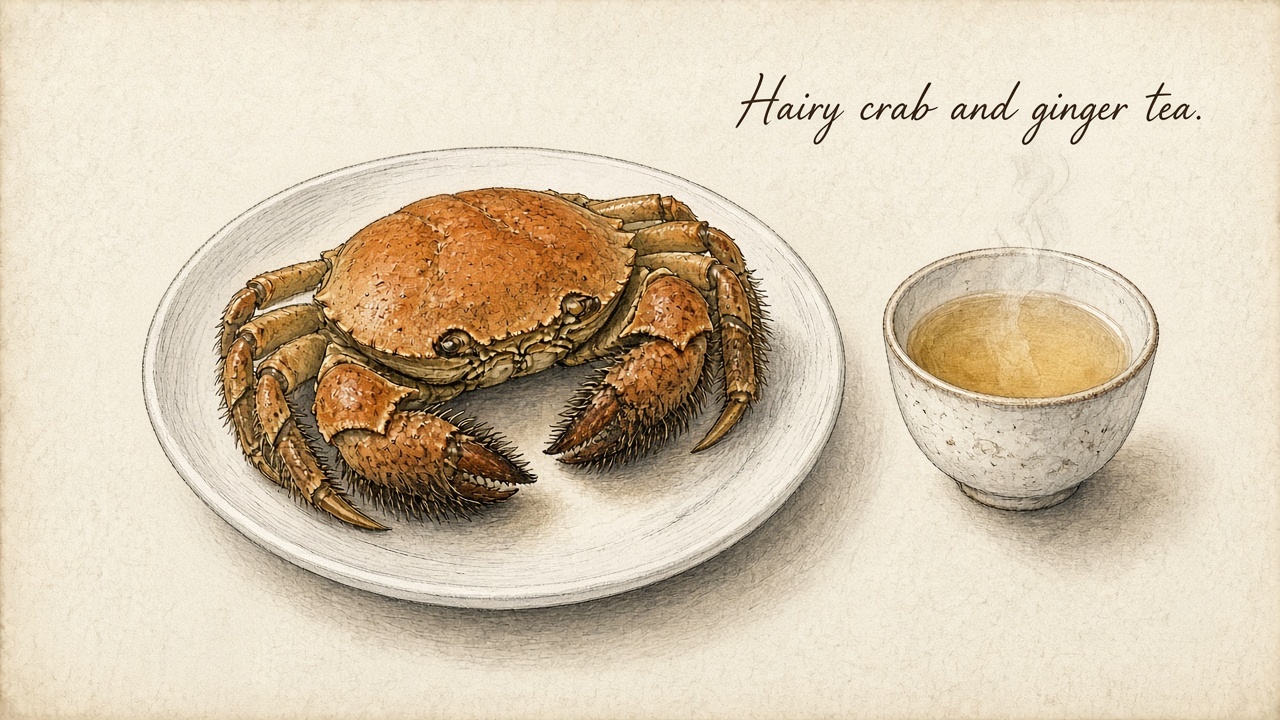
Every autumn, Hong Kong quietly rearranges its dinner plans around one small, furry-clawed crab. Shop windows fill with neat stacks of hairy crabs tied up in string, restaurants print seasonal menus, and families gather around a table of steamed crabs, black vinegar and shredded ginger. And when the shells are cleared away, there's often one last thing to come: a small cup of ginger tea.
If you're new to the season, here's what hairy crab is, how locals enjoy it, and where that cup of ginger tea fits in.
At a glance
✓ Hairy crab is a freshwater crab, best known from Yangcheng Lake near Suzhou. It's in season in autumn, roughly from late September to November.
✓ It's usually steamed whole and eaten with black vinegar and shredded ginger.
✓ Finishing with ginger tea is a long-standing custom in Hong Kong and Shanghainese homes: a tradition and a flavour pairing, not a remedy.
✓ No fresh ginger in the kitchen? Three drops of GINJER Forte in a cup of water make a quick ginger tea.
What is hairy crab?
Hairy crab is the Chinese mitten crab, named for the soft, dark fuzz on its claws. It lives in the lakes and rivers of the Yangtze region, and the most prized ones come from Yangcheng Lake in Jiangsu, not far from Suzhou. In Hong Kong you'll find them from early autumn, sold live and tied up with string or straw so they can't wander off.
Locals follow an old saying, "nine female, ten male". It refers to the ninth and tenth months of the lunar calendar. Female crabs are at their best around October, full of rich golden roe, while the males come into their own in November, when their creamy, sticky "paste" is at its fullest. Many crab lovers simply have both: a female early in the season and a male later on.
How Hong Kong and Shanghai enjoy it
Hairy crab is a Shanghainese delicacy that Hong Kong has made its own. The crabs are kept simple: steamed whole, still tied, and brought to the table glowing orange. Each person gets a small dish of dark Zhenjiang vinegar mixed with finely shredded ginger and sometimes a pinch of sugar, and a cup of warm Shaoxing wine is a classic companion for those who drink.
Eating one is an unhurried affair. You lift the top shell, scoop out the roe or paste, pick through the body and work your way along each leg. It's messy, sociable and slow, which is rather the point. At the end, many families and restaurants bring out a small bowl of ginger tea, often sweetened with brown sugar.
Why ginger tea after crab?
The custom has deep roots in Chinese food culture. Traditional belief sorts foods into "cooling" and "warming" kinds, and crab is thought of as cooling while ginger is thought of as warming, so older generations always served the two together for balance. This is a traditional belief, not a scientific or medical fact, but it explains why ginger turns up at almost every crab meal: in the vinegar, and again in the cup at the end.
There's also a simpler reason people keep the habit: it tastes good. Hairy crab roe is very rich, and the gentle heat of ginger is a natural match for it. A sweet, gingery cup at the end of the meal feels like a full stop, and for many people in Hong Kong it's simply what a crab dinner at grandma's always tasted like.
How to make simple ginger tea at home
With fresh ginger
1.Slice a thumb-sized piece of fresh ginger. There's no need to peel it, just give it a good wash.
2.Simmer the slices in two cups of water for about 10 to 15 minutes.
3.Sweeten with brown sugar or honey to taste, strain and pour.
With GINJER Forte ginger drops
After a crab dinner out, few of us feel like slicing and simmering. GINJER Forte is a concentrated organic ginger extract from Germany, so a cup of ginger tea takes about a minute.
1.Pour a cup of warm water.
2.Add 3 drops of GINJER Forte and stir.
3.Add a little honey if you like it sweeter.
The brand recommends 3 drops in water, once or twice a day. Don't go over that amount, and keep the bottle out of reach of small children.
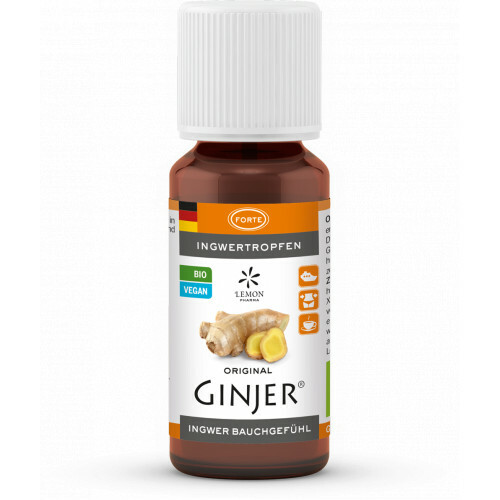
GINJER Forte Ginger Drops 20ml
What it is: ginger drops with 15.8% organic ginger root extract (20:1), made in Germany
How to use: 3 drops in water as a ginger tea, once or twice a day; a 20ml bottle holds about 450 drops
Formula: no added sugar (under 0.5g per 100ml), alcohol-free, lactose-free and gluten-free; vegan, halal and kosher
Tips for enjoying hairy crab
•Buy them live. A good crab is lively, feels heavy for its size and has a clean, glossy shell.
•Cook them on the day you buy them. Give them a scrub, keep the string on, and steam until cooked right through, usually around 15 to 20 minutes depending on size.
•Eat them soon after steaming, while they're still warm. Cooked crab shouldn't sit out on the table for long.
•Skip the gills, the small stomach sac behind the mouth and the heart in the centre. Everything else is fair game.
•One or two crabs per person is usually plenty. They're rich, and best enjoyed slowly.
•If you have a shellfish allergy, are pregnant, or have a health condition or take regular medication, check with your doctor before eating crab or taking a ginger supplement.
FAQ
When is hairy crab season in Hong Kong?
Roughly from late September to November. Female crabs are usually at their best around October and males in November, though shops and restaurants often keep serving them for a little longer.
Does the ginger tea have to be hot?
Traditionally it's served warm, but it really comes down to taste. Some people prefer it at room temperature, and that's perfectly fine.
Can I take GINJER Forte straight from the bottle?
It's meant to be mixed with water. The brand recommends 3 drops in water as a ginger tea; on its own the concentrate is very strong and spicy.
Is ginger tea after crab a remedy?
No. In Hong Kong it's a food custom and a pleasant way to round off a crab meal. It isn't a treatment for anything.
GINJER Forte is a food supplement. Health products such as vitamins and dietary supplements are not registered under the Pharmacy and Poisons Ordinance or the Chinese Medicine Ordinance, and any claims made for them have not been assessed for the purpose of such registration. They are not intended to diagnose, treat or prevent any disease.


![2026年 『 正版正貨承諾 』 零售網店會員資格 2024101 [ISO 9001:2015 認證]](https://shoplineimg.com/5df9cc887c4047002c9cceac/69831171cb4da0320bc889ba/750x.png?)


